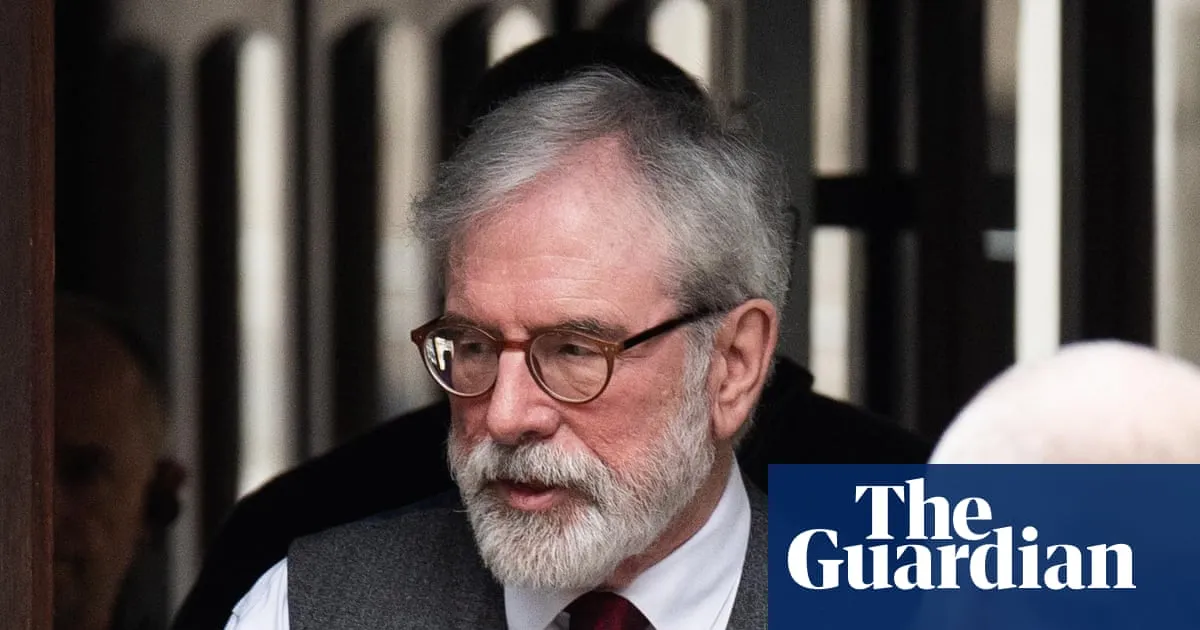
Gerry adams civil trial begins as claimants seek justice
Gerry Adams is currently facing a civil trial where three men are suing him for his alleged role in IRA bombings.
In a striking statement, Gerry Adams declared, “I’m here to defend myself and to challenge the allegations being made against me.” This trial, taking place at the Royal Courts of Justice in London, has garnered significant attention as it addresses the contentious legacy of the Provisional IRA and its impact on victims of violence during the Troubles.
The claimants, who are seeking symbolic damages of £1 each, allege that Adams was an instrumental force in organizing the Provisional IRA’s activities, including bombings that resulted in their injuries. Anne Studd KC, representing the claimants, emphasized the gravity of the case, stating, “Their focus is to shine a light upon the involvement of the defendant in the PIRA in the course of that conflict and to prove on balance of probabilities that he [Adams] was so intrinsically involved in the PIRA organisation that he is as culpable for the assaults giving rise to these claims as the individuals who planted and detonated the bombs.”
Adams, who was 77 years old at the time of the trial, has consistently denied being a member of the IRA and opposes the claims against him. His involvement in the peace process, particularly in the negotiations leading to the Good Friday Agreement in April 1998, has been a significant part of his public persona. However, the claimants argue that he bears responsibility for decisions made by the Provisional IRA regarding bombings, including those that occurred during the 1973 Old Bailey bombing and the 1996 London Docklands and Manchester bombings.
Edward Craven KC, representing Adams, contested the claimants’ assertions, stating, “The defendant’s alleged factual and legal responsibility for the claimants’ injuries is strongly contested, as is the claimants’ ability to bring these claims against the defendant several decades after the expiry of the applicable limitation period.” This highlights the complexities involved in legal proceedings related to historical events, particularly those stemming from a conflict as fraught as that in Northern Ireland.
The claimants’ case relies heavily on evidence from IRA volunteers and intelligence officials, which has raised questions about the reliability of the information presented. Critics of the claimants’ position argue that much of the evidence against Adams is predominantly hearsay and anonymous, complicating the pursuit of justice for the victims.
As the trial unfolds, the focus remains on the intricate relationship between Adams and the Provisional IRA, as well as the broader implications of the case for those affected by the violence of the Troubles. The trial is expected to conclude next week, and the outcome may set a precedent for similar cases in the future.
Details remain unconfirmed regarding the potential ramifications of this trial on Adams’s legacy and the ongoing discourse surrounding accountability for actions taken during the conflict. As the proceedings continue, both the claimants and Adams prepare for the next stages of this pivotal legal battle.