Argentina face FIFA fine after displaying Falklands banner following England match
Argentina’s World Cup Celebrations and Political Statement
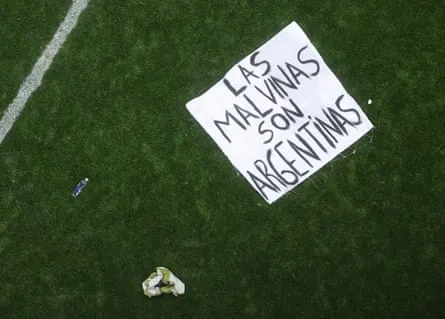
Following their victory over England in the World Cup semi-final, Argentina players displayed a banner referencing the Falkland Islands. The banner, which read “Las Malvinas son Argentinas” (The Falklands are Argentine), was held up after the dramatic 2-1 win in Atlanta. This action could lead to a fine from FIFA, the governing body for world football.
The display occurred after Argentina scored two late goals to overcome Thomas Tuchel’s side, securing their place in the final against Spain. The Falkland Islands, known as Islas Malvinas in Argentina, have been the subject of a sovereignty dispute between Britain and Argentina for an extended period. A conflict over the islands took place from April to June 1982, resulting in the deaths of 655 Argentine and 255 British servicemen, along with three island residents.
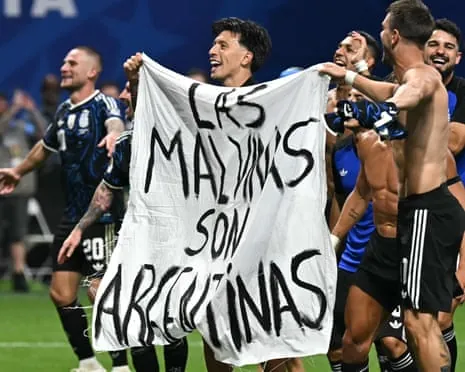
This is not the first instance of Argentina facing scrutiny for such displays. In 2014, the Argentine Football Association was fined £20,000 by FIFA after players held a similar banner before a friendly match against Slovenia. FIFA’s rules prohibit political actions and team misconduct, and the organisation had previously stated that the 2014 gesture breached these regulations.
Reactions and Security Measures
The incident drew attention beyond the football pitch. Argentina’s vice-president, Victoria Villarruel, posted on social media following the match, stating, “it wasn’t just another match” and reiterating, “The Falklands are Argentine.” She also commented that while bringing such banners to the stadium might be banned, the sentiment remains strong among the Argentine people. Prior to the semi-final, Villarruel had referred to the match as an opportunity to “put the invaders in their place.”
Despite these political undertones, Argentina manager Lionel Scaloni had expressed a desire to keep football separate from politics. He stated before the semi-final that he was “not going to mix” the two, acknowledging the 1982 conflict as a “very sad period” in history but emphasising that the match was purely a football event. He also noted that “things are happening elsewhere in the world, and we criticise the existence of war,” while still remembering those who were lost.
The semi-final itself was held under heightened security due to the historical tensions between the two nations. Security minister Alejandra Monteoliva confirmed that enhanced measures were discussed, with 1,600 officers deployed to ensure a peaceful event. The entry of any items with provocative messages, whether political or racial, was prohibited inside the stadium. FIFA’s stadium code of conduct explicitly bans “banners, flags, flyers, apparel and other paraphernalia that are of a political, offensive, and/or discriminatory nature.”
Historical Context and Player Sentiment
The dispute over the Falkland Islands, or Islas Malvinas, continues to be a sensitive issue. In 2013, a referendum was held in the islands where residents voted to remain a UK overseas territory. The historical animosity between Argentina and Great Britain was a factor in the increased security discussions involving the FBI, FIFA, and local police ahead of the match in Atlanta.
During earlier stages of the tournament, after defeating Switzerland in the quarter-final, some Argentina players were heard chanting about “the Malvinas, for Diego [Maradona] and for Leo [Messi]’s last one.” Argentina midfielder Rodrigo De Paul acknowledged that football can transcend the game, bringing back memories and honouring heroes, but also stressed the importance of discussing the Falklands issue in appropriate forums outside of football. He stated that while they remember the fallen, their primary goal in the match was to win and reach the final.
The semi-final saw England lose to late goals from Enzo Fernandez and Lautaro Martinez, further intensifying the emotions surrounding the fixture.
Read Also
Source: bbc.co.uk