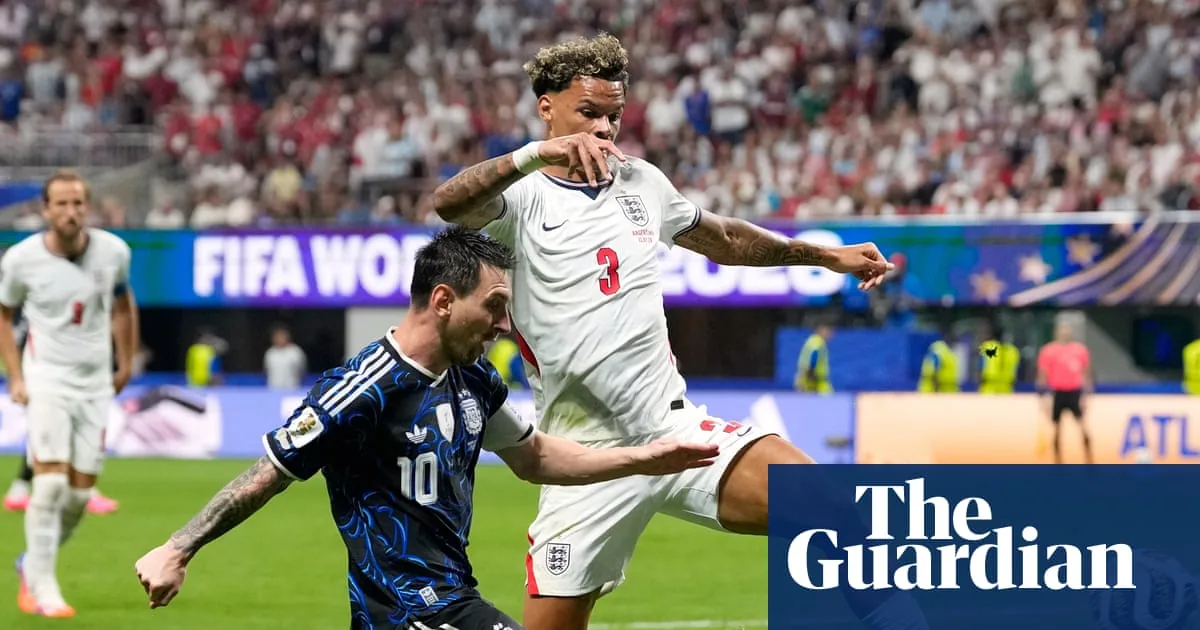
England squad debating Tuchel’s tactics after World Cup semi-final loss to Argentina
Following England’s 2-1 defeat to Argentina in the World Cup 2026 semi-final, discussions have emerged within Thomas Tuchel’s squad regarding the team’s tactical approach in the latter stages of the match. Reports indicate that several key players expressed disappointment with how the team handled the final moments of the game.
England had taken a 1-0 lead with 35 minutes remaining, appearing to be on track for their first men’s World Cup final since 1966. However, the momentum shifted significantly, with Argentina increasing their pressure. While it is natural for an opposing team to push for an equaliser, England has faced criticism for seemingly ceding the initiative.
Manager Thomas Tuchel implemented a back-five formation to defend the lead, but this strategy was ultimately overturned as Argentina scored two goals in the closing stages. Pundit Wayne Rooney attributed the defeat to the manager’s decisions.
Squad concerns over defensive strategy
After the match in Atlanta, players reportedly discussed the team’s setup after taking the lead, with some believing it contributed to their downfall. At least three senior players have privately voiced concerns about the team’s approach during the final moments of the game.
While players acknowledge that dropping deeper to defend a lead can be a natural instinct, there is a consensus among some that Tuchel’s tactical changes and substitutions intensified their defensive retreat. Certain players felt the team should have been given more freedom to press the ball, aiming to push Argentina further away from their goal and provide relief for the defenders.
Instead, some players viewed the team’s actions as simply clearing their lines and regrouping defensively, a tactic that not all agreed with. There is a sentiment among some that a bolder approach could have been taken in the closing stages, not necessarily to seek a second goal, but to balance defensive resilience with an attacking threat to keep Argentina on edge. One source commented that the team “went too deep too early.”
It is not uncommon for players to have differing opinions from their manager, but the level of consternation regarding England’s instructions for finishing the game could influence the dynamic between players and manager as they head into the European Championship qualifying campaign.
Tuchel’s perspective on the match
In recent comments to British newspapers, Tuchel addressed the tactical decisions. He stated that he had not yet reviewed the data but observed a dramatic shift in momentum, ball possession, and chances immediately after England’s goal. He noted that the team became too passive within their structure.
Tuchel explained that his intention with the back-five was to encourage more active play, to be quicker in engaging wingers, and to prevent gaps from opening in the defence, rather than to become more passive. He encouraged players to step out and be more active, but acknowledged that the team struggled to win duels, which led to them dropping deeper. He stressed that this was “never the plan but it happened.”
He emphasised the importance of regaining possession to break pressure and reclaim momentum. Tuchel also remarked that controlling the game with the ball might not be in England’s “DNA” in the same way it is for teams like Spain, Argentina, or Brazil, identifying this as a significant issue. He believes, however, that England players can still demonstrate their footballing quality, citing what he observes in training and at every camp.
Messi’s impact and tactical considerations
Before the match, Thomas Tuchel had prepared for various scenarios, including how to manage Lionel Messi. For the initial hour of the game, Messi’s influence was largely contained, with data indicating that England limited his involvement in dangerous areas. His only possession in the centre of the penalty area was intercepted by Elliot Anderson shortly after Anthony Gordon’s goal.
Messi’s sprinting speed percentage was lower than in previous rounds, and his only shot was from long range and blocked. This limited offensive output from Messi was a positive sign for Tuchel. While it would be an overstatement to say England had him precisely where they wanted him, Argentina’s captain was operating in areas that could be anticipated and planned for.
However, a subtle shift occurred in the second half. Messi began to operate from the flank between the edge of the penalty box and the touchline, attempting six open-play crosses from this region. This was a notably high number for him, as he typically averages 2.3 crosses per 90 minutes across league football since 2015. One of these deliveries led to a header from Nico González, which Jordan Pickford saved.
This moment may have influenced Tuchel’s decision to bring on Ezri Konsa, followed by Dan Burn, and switch to a back five. While a similar strategy had been effective against Mexico, Messi’s crossing ability proved to be a different challenge. His cross for Lautaro Martínez’s winning goal generated 0.53xG, surpassing England’s total for the entire match. This was only Messi’s second World Cup assist with his right foot, highlighting the unexpected nature of his decisive contribution.
Despite England’s run to the semi-final being considered an achievement by the Football Association, the circumstances surrounding their loss to Argentina will be reviewed once the team returns home after Saturday’s bronze medal match against France.
Read Also
Source: bbc.co.uk